At the agreed time, Monika, Tomáš, and I sat by the right leg of the Eiffel Tower, on the side facing downstream along the Seine, as arranged with Karel through our many letters.
Tomáš, Komik, Helenka in the front, others in the back
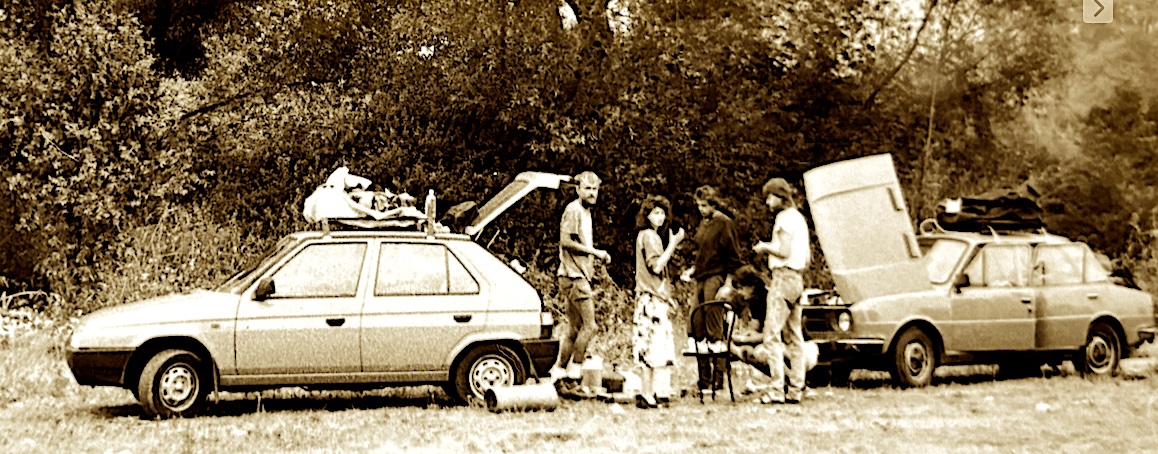
We were sipping wine, and the passing tourists mostly ignored us. On the roundabout in front of the tower — the one with maybe five lanes — an old Škoda 105 stopped first, followed by a newer Škoda Favorit. Doors opened, and several people jumped out, including Hrdláč, a buddy who had brought us together, carrying a demijohn of homemade wine. They all ran toward us, leaving the cars abandoned on the busy roundabout, and we hugged cheerfully. Sixteen of my old and new friends were there along with me at that moment. Before long, we went to the nearest shop for more bottles and cardboard boxes of wine and spent the evening thoroughly drunk beneath the new Eiffel Tower.
Váca and Hrdláč on the left
Enthusiasm knew no bounds. It was the vibes after the Velvet Revolution — we were thrilled to travel freely and I was happy to see friends again after my two years in North America. The nineties were just beginning, a time when anything seemed possible. That night, we even climbed the tower as far as we could. Back then, it all felt achievable — unbelievable now.
In the morning, a gardener watering the grass woke us, and we set off to explore Paris: the Louvre, Pompidou Museum, Montmartre, and more. We spent three nights there.
Hrdláč, myself, Helenka and Váca exploring Paris
Myself, Helenla, Samson and Hrdláč in the streets of Paris
Afterward, about half the group returned to Bohemia, while a few friends and I set off in the Škodas through southwestern Europe. Our first stop was Lourdes in southern France, as Váca — my college roommate from Plzeň University, living in East Berlin — wanted to visit the pilgrimage town.
Czechs invading the West
Heading west toward Spain, starting with the Pyrenees, we ran into car troubles. The old Škoda 105 had worn-out tires. After a few hundred kilometers, wires showed through, so we stopped at a farm with a silage pit and a pile of old tires. We found two that fit and somehow mounted them. Fifty kilometers later, the same thing happened. The main issue was the car’s alignment.
When cattle shit dries out, you do not need fire wood
Still, we managed. Along the way, we reached the Pyrenees and spent a night under the stars near a peak, gathering dried cow dung for a fire in the hot evening. As the saying goes… shit does burn!
Hrdláč, demijohn, bush, sofa and I somewhere in Southern France
We slept in various spots — once near a landfill, using old furniture and junk to create crazy photos. We visited Barcelona, Figueres for the Dalí Museum, and Madrid for the Prado Museum. The demijohn traveled with us, and at each stop, whoever had it would run to the other car to share a drink.
Karel making Helenka even more beautiful (married for 40 years)
Breakfast in Europe
Naturally, there were incidents: a motorcyclist crashed into a car door while transferring the demijohn, and once, our car was broken into and belongings stolen. Still, the journey was fun. We reached southern Spain, Granada, and the mountains of the Sierra Nevada.
Helenka and the neighborhood
Eventually, we turned back, crossing Spain, the Pyrenees, France, Switzerland, Germany, and finally back to the Czechoslovak border. After two years in North America, as planned, I returned home, paying tribute to Jack Kerouac’s (who inspired me to that adventure by his novel On the Road) grave in Lowell, Massachusetts, and arriving in time for my father’s 50th birthday. The Iron Curtain had fallen, and a new chapter in Europe and my life was beginning.
From Alaska, I started to hitchhike back home, through Yukon, New Your City, London, Paris, Madrid.
I still had about three weeks before I promissed to be in Paris. So I made a hitchhiking sign that read “Paris SVP” — S’il vous plaît in French — and began hitchhiking. Cars were few and far between, maybe one every hour, but in the meantime I was reading Illusions by Richard Bach, so it didn’t bother me too much.
This is already somewhere in Sasketchwan, half way through from Alaska to New York City
When a car did come by, people would look at the sign, tap their foreheads, smile a little, and usually drive on. Still, after a few hours, someone finally picked me up, and I made some progress heading toward Yukon, Canada.
In Whitehorse, the capital of Yukon, I wanted to withdraw some money — but since I hadn’t used my bank card for quite a while, I’d forgotten my PIN code, and the ATM swallowed my card. I had no choice but to wait the entire weekend until Monday, when the bank finally returned it to me.
From Whitehorse, I continued hitchhiking to Skagway, a town that lies once again within Alaska, in the United States. It’s part of what’s known as the Alaska Peninsula — a region of Alaska that’s accessible only by sea or air.
Chilkoot Pass during the Gold Rush
Back in the days of the Gold Rush in the 19th century, when prospectors learned that gold had been discovered in Dawson City, thousands of them rushed to this area. They could reach Skagway by ship from California, but from there they had to cross Chilkoot — a mountain pass that could only be traversed on foot.
I decided to hike the Chilkoot Pass Trail myself; it took about two or three days. What made it especially fascinating were the signs and information boards along the route, describing in detail what had happened there a hundred or even a hundred and twenty years earlier.
The landscape looked almost untouched, and after those 120 years there was hardly any sign that a kind of civilization had once sprung up there within just a few weeks or months. The gold seekers had carried their supplies over the pass — which even with just my backpack I found quite difficult — and they were hauling things as heavy as pianos and other equipment.
In Dawson City, within just a few months, an entire town had appeared — with banks, brothels, boarding houses, and everything else that came with it. It’s truly incredible how quickly people can adapt to a new environment — and just as incredible how, once they leave, nature reclaims almost every trace of their presence.
My journey across the Chilkoot Pass ended back in Canada, in the Yukon. From there, I returned to Skagway, where I boarded a regular ferry bound for British Columbia. I had only bought a ticket to the nearest stop, but I ended up staying on board all the way to Prince Rupert in British Columbia, which took nearly 4 days.
I slept in my sleeping bag on a foam mat on the upper deck, which was heated by gas heaters. Along the way, we passed through Alaskan towns like St. Petersburg and Juneau, sailed past glaciers, and even saw whales swimming near the ship. It was an absolutely magnificent journey.
From Prince Rupert, I started hitchhiking again, this time heading east. I wanted to get to New York as quickly as possible. Almost on my first attempt, I managed to catch a ride with a couple traveling in a caravan all the way to Calgary. I spent two days there because a cowboy festival was taking place at the time.
Iconic Lake Luise in the Banff National Park, Alberta and a local chipmunk
Then I visited some famous parks in Alberta like Banff and Jasper, and continued east through Saskatchewan, Manitoba, and Ontario all the way to New York. In total, the hitchhiking journey from Alaska to New York, some 7 200 km, e.g. close to what I plan to hike at Te araora and PCT in the upcoming 12 months. took me 12 days while hitchhiking.
I didn’t have much time left to get back to Paris by the agreed date, as I had arranged with my friend Karel. For practically the entire two years — or, you could say, since the Velvet Revolution in Czechoslovakia — Karel and I had been planning to meet somewhere once I returned from Canada. We decided it would be in Paris, and of course, all of this was now possible because people from Czechoslovakia could finally travel freely.
Karel (middle), myself (on his left) and other friends in Paris, July 1991
Basically, in almost every letter we exchanged with Karel, my friend from the university — at least twice a week, each often several dozen pages long — we bizarrely went into minute detail about how our meeting in Paris would unfold. We agreed that it would be under the Eiffel Tower, and then we even debated which leg of the Eiffel Tower we would meet at, whether it would be along the bank of the Rhône River or the opposite direction. We just wanted to kill time and never let go of the thought that it would really happen — that after my two years spent in emigration in North America, we would finally meet in Paris.
I am 35 years older now and the Twin Towers have been 25 years gone
As soon as I arrived in New York, I basically headed straight to JFK, and you could almost say I was hitchhiking there too. I went up to the counter where tickets were sold and asked if they had any last-minute flights to Europe, saying I’d be interested. I sat down, and it didn’t take long before the lady at the counter called me — they had a cheap Virgin flight to London. I think it cost around $200, so I bought it immediately, and within a couple of hours, I was seated on a plane heading to Europe.
I spent about two or three days in London as well. What I remember most is sitting in Hyde Park, listening to various speakers talk on all sorts of topics. Then I bought a bus ticket to Paris and arrived on the agreed-upon day — I think it was the first or second day of July 1991. I went straight to the Eiffel Tower.
There were so many people around, and as I was walking through, suddenly someone tapped me on the shoulder. I still had my backpack with the Czechoslovak flag on it, and when I turned around, there was a guy with a girl. I didn’t know them, and they said, “Hey, aren’t you Sápa?” I said yes and smiled, and they told me they had come all the way to see me.
Eiffel Tower, July 1991. Myself (sitting in the middle) and my friends
It was Tomáš and Monika, my buddy Karel’s friends, who had organized everything so that in the end 16 people came to Paris to meet me. Some of them hitchhiked all the way from Czechoslovakia, while others arrived in two cars — one an old Škoda 105, the other a nearly new Škoda Favorit. And so, after two years, we finally met. I’ll tell the rest in the next post.
By coincidence, I was once again picked up by some German students. When we arrived in Fairbanks, it happened to be June 21st, the summer solstice. We camped in someone’s backyard, pitching our tent there, and then went to a pub to celebrate the solstice. I remember the pub had all its windows closed and darkened, and we drank quite a few beers, playing pool and darts and so on. When we finally stepped outside around two in the morning, the sun was still high in the sky — and it was about 30 degrees Celsius. I have to say, it was quite a rough night: the tent was stiflingly hot, and on top of that, my head was pounding from the party in that smoky bar.
Mount McKinley
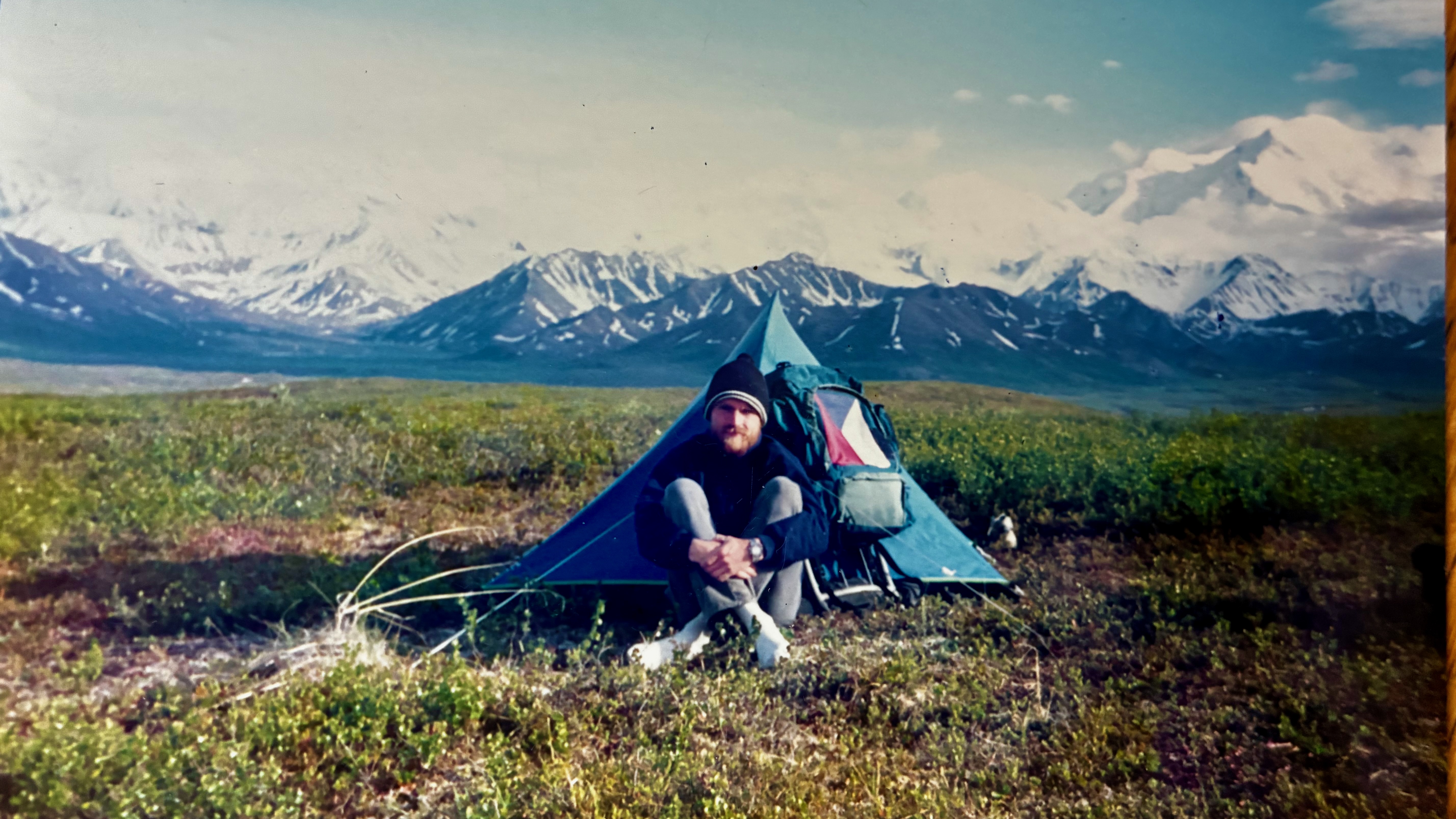
I then hitchhiked to Denali National Park, the area surrounding Mount McKinley. There I met two guys from Israel who had just finished their compulsory military service and were traveling around the world. Together we set out early into the vast open plains around Mount McKinley. The weather in this region is known to be mostly gloomy and overcast, but we were lucky — for three days the sky was completely clear and bright blue. Very soon we…
Tal, my buddy from Israel, he saved my life pulling me from the Mc Kinley river
I set out with my two new partners from Israel across the plains toward Mount McKinley, which was completely covered in snow — the views were absolutely breathtaking. As I mentioned, the landscape was mostly open plains with few trees, so we could see incredibly far. On our way, we had to cross a small river, also named McKinley. We camped for the night just below the glacier, and the next day we climbed right up onto it. The weather was perfect, and I was truly enjoying every moment — taking lots of photos, including a few rather bizarre ones, like this one here.
I was all wet and frozen to death, but alive
The journey back turned out to be a bit more dramatic. As I mentioned, the sun had been shining for three straight days, and that small McKinley River had turned into quite a strong and wide stream. When I tried to cross it, the current swept me away, and I ended up being carried about 20 or 30 meters downstream, backpack and all. One of my two Israeli friends — I can’t remember either of their names anymore — managed to reach me just in time, handing me a long stick and pulling me out of the water. I remember that moment vividly, and ever since then, I’ve had a healthy respect for river crossings — something that would later come in handy during my travels in New Zealand, where I’d be fording rivers almost every day.
After I had dried myself, my sleeping bag, tent, and everything else, we started preparing dinner. Suddenly, I looked up — and about 15 to 20 meters away, there was a grizzly bear. I was just cooking my meal, while the two guys from Israel were about 200 meters away. The grizzly stopped, stood up on its hind legs, and began sniffing the air. At that moment — and I’d already seen quite a few bears before — I have to admit I was pretty scared.
Thanks god this grizzly was not interested in my food and walked away
I tried to think what to do: should I leave the spot and let him have the food, or should I somehow try to scare him off? I decided to stay completely still, just as I was. Fortunately, after a short while, the grizzly got back down on all fours and slowly wandered away.
3-day solo hike in the Kodiak Island
Then I said goodbye to my Israeli friends and hitched on to Kodiak Island, where I did a solo two- or three-day trek. I remember that I didn’t meet anyone at all for most of the hike, but as I was getting back toward civilization and walking along a medium-sized river, I saw a woman with a child — and a backpack — about three hundred metres ahead. When I was ten metres behind her I thought it would be polite to make my presence known so as not to startle her, so I coughed. In that instant she turned around and I found myself staring down the barrel of her revolver. She was clearly experienced and knew how to defend herself, but when she realised I was just a fellow hiker we both laughed, and I walked with her to the end of the trail.
Denali National Park
At about 5 000 m above see level under Mt. McKinley (6 190 m asl)
At the end of May 1991, it was time to start heading home — just as I had originally planned, spending two years in America. I flew from Montreal to Vancouver, where I spent a few days staying at a youth hostel. That’s where I met Steve, who had come from Georgia and was on his way to Alaska, planning to spend some time working on fishing boats. He was traveling with his husky and an old Volkswagen minivan.
Steve and his van
Steve offered me a ride, so we soon set out together on the Alaska Highway toward Alaska. The journey took us about three or four days. Calling it a “highway” is a bit of an overstatement — parts of the road were basically dirt tracks, with only some sections paved. The farther north we went, the longer the days became, and we could see more and more mountains along the way. I was incredibly excited, eagerly looking forward to finally reaching Alaska.
There were buffalo or moose often alongside the road
I’ve forgotten the name of his husky, but it was clear how much he was enjoying the journey north. He seemed to relish the idea of returning to the place he truly came from. No wonder — Georgia, located in the southern part of the United States on the east coast, has a completely different climate than his usual homeland. When we arrived in Anchorage, Steve and I said our goodbyes. I explored the city for a while and then set out hitchhiking north to Fairbanks.