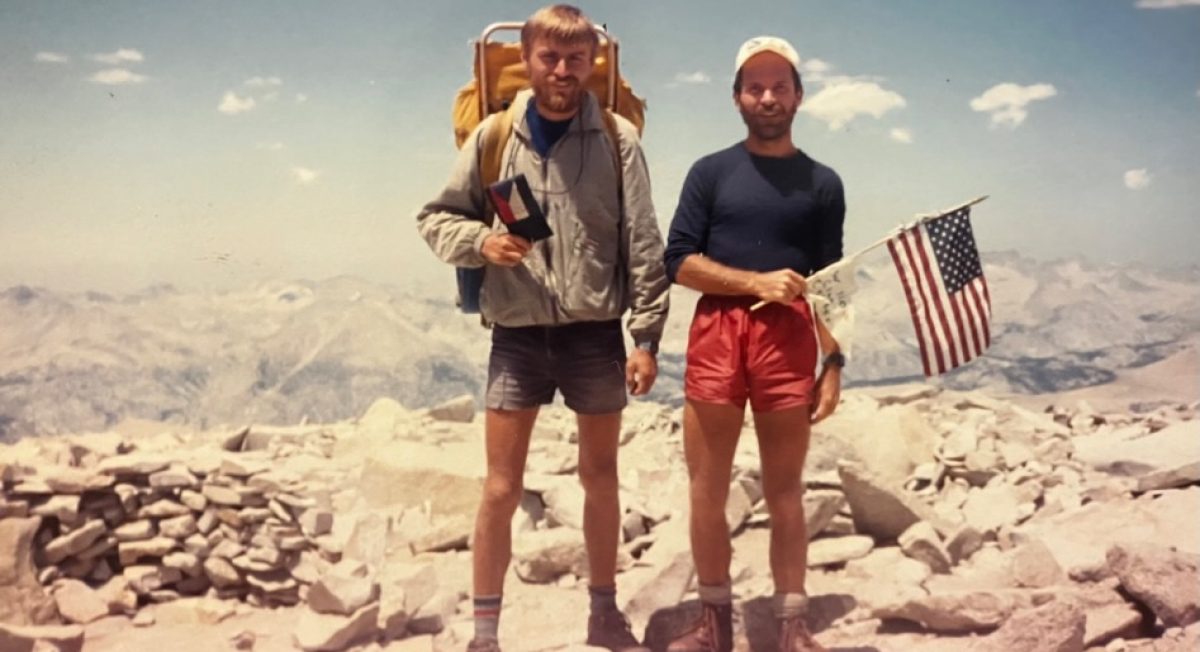
Crossing the Sierra Nevada was one of the most profound experiences of my life. During those twenty-two days, we met only four other people — but quite a few bears. The weather was beautiful. Every morning around ten, intense but short thunderstorms would roll in however, soaking everything, yet by noon the sun was shining again, and within moments everything was dry once more.

Each day we crossed a mountain pass at elevations between 3,500 and 4,000 meters above sea level, then descended into a valley — down to about 3,000 meters — where we camped for the night. I remember that every evening, once we arrived at our campsite, I always made myself a cup of hot cocoa.

Every evening, I would look down into the valleys at the beautiful lakes and mountains and write letters. I wrote at least one letter every day, often running into dozens of pages. I wanted to share my experiences — those views and feelings — with my friends and family.
We crossed Sequoia National Park, Kings Canyon National Park, and of course Yosemite. After about ten days, we finally came to a small cabin with a tiny shop inside. There, we were able to restock our food supplies — mostly oats, raisins, nuts, and some jerky. I also needed new shoes, since the sneakers I had completely fell apart.
By coincidence, next to that little store — which was in the middle of nowhere, just a single man running it and no sign of any village or settlement — there was a pair of used hiking boots. It was clear that someone had left them there for others to take rather than throw them away. I tried one boot on. They were about two sizes too small for me, but otherwise in decent condition. I told myself that I could manage the remaining two hundred kilometers in them.

As we got closer to Mount Whitney — the final goal of our journey — our food supplies were running low, and I was also secretly wishing for my backpack to get lighter. It had weighed around 30 kilograms when fully packed with food. Every time I finished a small bag of oatmeal for breakfast and burned the empty wrapper, I would ceremoniously think to myself that my backpack had just become a little lighter.
These small rituals somehow made the journey even more meaningful — step by step, as we kept moving forward along our trail.

I also remember several moments when I sat in a meadow, feeling completely cut off from any form of civilization — which, in truth, I was. I watched the chipmunks happily running around, and I felt completely connected with the entire universe. They were magical moments.

I also recall how, during those twenty two days, my heavy backpack gradually became part of my body. Whenever I took it off, I felt like a snail that had just crawled out of its shell. I did wash myself occasionally — I had a special kind of shampoo that was safe to use in mountain streams and wouldn’t harm the water — but over time I simply got used to my own smell and stopped feeling uneasy about not being able to wash regularly.

After twenty two days, we finally reached Mount Whitney, 4 400 meters above sea level. There were lots of people who had come up from below, from the Mojave Desert, near a small town called Lone Pine, which is the access point to the mountain. We took some photos at the top and then started our descent — almost 3,500 meters down. It was quite demanding, but when we finally reached Lone Pine, we rented a small room in a guesthouse and bought a huge pizza — nearly 60 centimeters across — and ate the whole thing.
Later, lying in bed at the guesthouse, we turned on the TV. I remember that moment as if it were yesterday: on the screen, Pink Floyd’s The Wall concert was being broadcast live from Berlin, celebrating the fall of the Iron Curtain and the tearing down of the wall between East and West Berlin. It was a symbolic moment — one that marked the end of the Cold War and, in a way, the final echo of World War II. I was deeply moved; it was an unforgettable, powerful moment.
The next day, after saying goodbye to John, I hitchhiked south to circle around the Sierra Nevada. I wasn’t sure whether I’d head to Los Angeles or San Francisco — it didn’t really matter.

A car gave me a ride to an intersection in the Mojave Desert, on the southern edge of the Sierra Nevada, and dropped me off there. It was just a crossroads — one road led to Los Angeles, the other to San Francisco — and there was absolutely nothing around.
I kept hitchhiking, but hardly any cars passed by, and those that did didn’t want to stop. I ran out of water and started getting really thirsty. After about two hours of desperate hitchhiking, I finally stepped right into the road and stopped a car, asking the driver if he could take me somewhere with water. The man picked me up, gave me a few ice cubes he had in a cooler, and dropped me off about twenty kilometers away at a gas station — still in the middle of the desert, with nothing else around.
I remember buying six cans of beer there and drinking two of them before I even paid. Then I staggered about twenty meters behind the gas station, crawled into my sleeping bag, and fell asleep, completely exhausted.
I woke up early the next morning, around four o’clock. The entire desert was glowing red, and on the horizon, the red peaks of the Sierra Nevada stood majestically against the rising sun. It was a breathtaking view — one I still remember vividly — and I’ve always hoped that one day I’ll return to that exact spot in the desert. I truly hope I will.

Leave a Reply